Showing posts with label Menstruation. Show all posts

Friday, December 2, 2016

Unknown Author: Who Wrote this Book Review on: Archives of the Vagina: A Journey through Time?

~ ~ ~ ~ ~
by Unknown Author
Here is the book review that got me to appreciate the huge impact that one book review has on a book.
“Archives of the Vagina, a journey through time by Margaret Aranda MD.  Although Dr Margaret Aranda’s book is a serious book written about serious issues it is often funny, she “threw her panties out the window.” But why would any young lady want to do that? And sometimes it’s rather like a detective story with unusual facts, such as, “Some women have died using a tampon.” And there is good practical advice concerning putting in your first tampon and when best to do so that it goes in easier.
Dr Aranda brings up the subject of sex openly; and encourages women to do the same and to talk with their doctor or close friend about it. Body language can play a major role here; and the use of innuendo and imagination is found to be equally important as well. There are serious health warnings; that “sex before marriage or with a person you don’t know can be fatal.” Sex talk becomes more intimate, “if she has an orgasm she desires you. It is sexy to a woman that you care more about her than yourself… You care how she feels… Care enough to use a condom… Most women do not experience orgasm with a penis. It is mainly down to the male, he must make her comfortable. That she is not being abandoned. If she is relaxed, only then might she have an orgasm.”
Basically there are 3 holes to look out for in the vagina. There are diagrams to aid the reader and health research charts. And many good tips, for example, if women go to the toilet before having sex it may help to prevent Unitary Tract Infection (UTI). Every abbreviation is made clear. There are also healthy suggestions when making love. For instance, rectal sex is dangerous; women can get bacteria E coli. Keep your fingers away from her urethra (pee hole) located between the vagina and clitoris. Instead lubricate her with love… and how to find the G Spot. That there are two kinds of orgasm; in fact, a woman can have several orgasms following each other.
Other health conditions are also mentioned such as, Anorexia nervosa and bulimia. Dr Aranda gives detailed explanation of the difference between these two conditions. That both conditions can lead to death. Also included are, cancer, diabetes, and postnatal depression and many more, and offers practical advice concerning these conditions and how to avoid them where possible.
I particularly found the chapter THE MOTHER fascinating and some of it is very witty. At the end of most chapters there is a quote of wisdom, here is one of them; “No matter what you do, someone will not be happy, someone will not agree, someone will criticize you. Make sure that person is not you!”
Some historical characters are mentioned and their achievements and contributions to society, such as; William Thomas Stead who made great contributions against child abuse. And Jacqueline Cochrane (1938) who won the Bendix Air Race; at this time it was widely believed by men that menstruation would hinder women’s performances in whatever work they did. Therefore her achievements proved that women could perform and function equally as well while on their monthly cycle.
The Normal Changes of Ageing in Women this chapter I found enthused with medical terminology. There are also many radical ideas untypical of today’s society. One Spoon at a Time, “Being on a diet implies suffering, withholding quality of life and deprivation… Exercise is not a chore. It’s an accomplishment.” Basically makes you happy, and there is a reason given why this is. There is an excellent table chart to aid the reader, and GI value list. And book recommendations such as, Jen Zerling – Breaking the Chains of Obesity.
How many of us knew that, “Too much urine production can lead to dehydration.” Nonetheless, it’s good to drink plenty of fluids, helps “fight off infections”.
Most of us have learnt to trust other bodies and organisations to keep us healthy and strong whether TV adds, health professionals and so on. But Dr Aranda (P.184) says it’s a mistake. “You cannot count on the government or insurance company to keep you healthy. You can only count on yourself.” (P.186) “Immunonutrition is cutting – edge for you right now, and I want you to know. Morcellation of the uterus and Essure ® nickel coils are 2014 issues that need to simply end and not get passed on to the next generation.” Another chapter that ends with a quaint short quote, “I alone am responsible for the quality of my life.” – Susan Barbara Apollon
MENOPAUSE AND QOL (p. 187) begins with brief introduction to the French physiologist and neurologist Charles-Édouard Brown-Séquard who “used animal ovary extracts for treating menopausal women”. So what better way to begin than with simple definition of menopause?
1) The ovaries no longer function
2) The monthly menstrual periods have stopped

Also discussed at some length throughout is “hormone-replacement therapy” (HRT) “To alleviate symptoms, most especially hot flashes and vaginal dryness,” which “the FDA approves” (HRT) “because the QoL issues are so important.”
Other definitions are also given for the following;
1) Premature Menopause
2) Perimenopause
3) Surgical Menopause
4) Postmenopause
5) Male Menopause

And (p.194) “Menopause occurs when the ovaries cease to function and there has been no menstruation for one calendar year. Now she is postmenopausal.”
There is also a relatively simple “quality of life” (QoL) self-tests provided, well worth setting aside some quite time to take this self test.
PAIN ON INTERCOURSE
I especially like the quote at the end of this chapter; “You were never created to feel depressed, defeated, guilty, condemned, ashamed, or unworthy. You were created to be victorious. “- unknown
although this is aimed at women, it is useful for men to know as well so they may point women in right direction. As there are given a whole heap of reasons a woman may get pain with intercourse. Apart from the obvious that she and her partner may no longer love one another.
SURICAL MENOPAUSE AND TESTOSTERONE THERAPY
This chapter provides detailed explanation of the following; hysterectomy, and several ways it can be performed. And also types of hysterectomy there are. And short paragraph on how it has developed through the ages. (P. 238) provides some astounding statistics, for example, “In 1988, the American Medical Association analyzed 700,000 hysterectomies per year, finding that 50% were “unnecessary.” If the ovaries are normal yet removed during a hysterectomy, menopause will instantly occur after surgery. This is known as surgical menopause. And (p.240) there is a Table 1. Risk and Benefits of Several Hysterectomy Procedures and (p.242) there is discussion concerning the risks involved with having hysterectomy. And (p.243) explains why you need your ovaries and the importance of keeping them. This is further endorsed on (p.244) “If your ovaries are normal, their estrogen, progesterone and testosterone production may serve to protect you from heart disease, bad moods, insomnia, vaginal dryness, fatigue, losses in bone density, and hot flashes, to name a few.”
Concerned whether you should keep your ovaries or have them removed (p.245) Dr Arana says, “Keep your ovaries unless you are at increased risk of ovarian or breast cancer.” And she provides a number of reasons of “How do you know that you are at increased risk?”
There is also a further chapter (p.246) on THE DIFFERENT TYPES OF HYSTERECTOMIES with some very interesting statistics, such as, Table 1. A Hysterectomy is a Major Surgical Procedure. In a 2004 study by the Hysterectomy Education and Resource Services wherein a second opinion and counselling were sought before hysterectomy, 98% of the hysterectomies were determined to be unnecessary.” Included is an in-depth discussion on anesthesia. Women are advised before singing the Consent Form, to make sure they understand what they are agreeing to have done. Because “once your uterus and ovaries are gone, you can never get them back.” Dr Aranda, says, “I have spoken with many women who had no idea that their ovaries would be removed, and that they would suffer afterwards.”
OVARIAN CONSERVATION, ETHICS, AND INFORMED CONSENT (P.252) Dr Aranda makes a very bold statement that according with medical practice is precise, “Ovarian conservation” refers to the practice of keeping the ovaries at the time of surgical menopause, or hysterectomy, for a benign cause. Specifically, in this case, to “conserve” the ovaries, one does not take the ovaries out at the same time as a hysterectomy for a non cancerous uterus or ovary. Please bear in mind that removing the normal ovaries equates to castration of the female. While this may seem to be a severe word, it is nonetheless a word that would be equally applied if we were talking about surgically removing the testes out of a man.”
MEN, MENSTRATION, AND MENOPAUSE (P.260) Begins with very endearing paragraph. A romantic notion passed on from father to his young daughter about menstruation. When Dr Aranda, was a child she had asked her father in all innocence what “rape” meant. A word she had read in a book. His answer though silent was sufficient to let her know what it might mean. It’s rather a long quote so suffice to say one must read it in context to appreciate it as it was between father and daughter, a very bright young daughter that was quick to learn what he meant.
However, (see p.262) it wouldn’t be unusual if men notice this more than women, that while most men do not like talking about women’s periods at all as Dr Aranda points out, “Other men have observed that they can pick up on the pheromones their woman excrete when she is on her period, stimulating the man to have increased sexual desires or libido.” The rest of this paragraph is extremely interesting and the findings of which most fascinating. However, it’s a rather long paragraph to quote and again one would need to read it in its entirety to appreciate its meaning.
Nonetheless, over the page is a funny quote “For a man’s insight on menstruation blood,” in this particular instance a young man talking with his “teenage sister”, who had “explained” to him “that she had become a woman.” and though I will not include the entire paragraph as this review or critic is already rather long, he concludes his understanding by saying, “So, largely, I did what my older sister told me, because it was obvious that she was a werewolf.”
There is a list to follow concerning men and menstruation and their notions about it. Basically some men act in a positive and sensitive way about it that women appreciate while other men are a complete and utter “jerk”.
Naturally I’m having to skip a lot as this is a 501 page book, but the aim and hope of my writing this review is at least to present and gave some idea of what it contains and how it is written.
FROM THE INSIDE OUT (p.267) immediately I wondered what on earth does this mean, nevertheless, Margaret Aranda, MD begins this chapter by asking and answering this very question. She never writes to confuse her reader with pent up jargon or intellectualism, though this is an intellectual book, she makes things perfectly clear: she says, “What does that mean, “From the Inside out”? It means that the inner beauty of a woman is not commensurate with her nose, her lips, her breasts, or her waist line. Inner beauty only comes from within.”
DIVORCE (p.270) Dr Aranda, is speaking from personal experience. She arrives home to a quiet empty house, “too quiet” her husband is gone and he has taken many items with him but above all, he has taken their little boy as well. She is faced with the dilemma of what to do and who to turn to for emotional support and advice. Some of her friends and family criticize her harshly for pursuing medical career when she has a young boy to take care of, but the rest of her friends and family gave her encouragement to continue with medical school. She uses a drove of superfluous words to describe her situation and how she felt. But nothing was going to deter her. She was going to come out on top. 15 years pass-by when she makes up her mind to get married again. But everything would be different this time and she would have a romantic wedding. In due course another child comes along, this time a baby girl. But 7 more years pass and then to her horror she discovers her husband is not the family guy she thought she had married. And once again, she is faced with prospects of another divorce and what to do for the best.
The following chapter Immunonutrition and Fish Oil although is relatively short it is full of content. Traditionally we are taught “we are what we eat”, but Dr Aranda, takes it a step further by introducing a new concept; she explains how some foods can purify the body because certain foods we eat can “tear down the bad”. Food that can be digested before and after surgery are also discussed, “should you take fish oil before surgery?” I would say, “Yes, after you ask your doctor.” And a diagram of Plasma Membrane Structure can be found on (p.277) showing benefit of, “Omega 3 fatty acids”. Several types of fatty acids are mentioned in this chapter and list of benefits they have on one’s health.
Raising Women (p.282) is partly about child development. Dr Aranda says, Firstly we learned that we were different from boys. We were “missing” something, you know. It was funny for many of us to the point of giggles…Later, we learned that we get our periods and we have to wear a bra. And she includes many other things women do and desire all part of growing up. The material and the physical; from having babies, sharing with other mothers rearing children or not having babies, to postmenopausal years. This chapter also includes a discussion on Immunization, for girls and boys ages from about 9-26, that the Federal Advisory Committee and the American Cancer Society endorsed, for example; the Human Papilloma Virus (HPV) vaccine preventing cervical cancer.
However she goes onto say, one of every 914 girls vaccinated by Merck during their own trials with Gardasil ® have died. Leaving a big question mark…She therefore advises, to do your own research before subjecting your daughter to something you don’t know about. That is the message from the mothers whose daughters have died. (See p.283) There is a list of interesting statistics on (p. 284) and rest of the chapter gives good sound advice, such as; why can’t we teach our daughters to get their annual Pap smears (which they will need, even if they get the vaccines that can cause death)? Our daughters need annual Pap smears. That is the answer. Period.
INVISIBLE ILLNESSES (p.288 – 296) is precisely what this chapter title suggests. That begins with a suitable definition, an “invisible disease” is not visually apparent. There are no glasses worn, no wheelchair, and no contraptions. The person looks “fine” to everyone and may act fine or be ok when lying down in bed, for example. But before Dr Aranda, goes on to talk about her own situation and experiences (as she suffers from an invisible illness called Dysautonomia), she mentions how it came about as a direct result of a serious motor vehicle accident. That she and her daughter was involved in 2006. Their Ford Expedition was hit by a lady driver that drove her BMW without due care and attention. The lady was probably coming from Chinese takeaway as she was reaching over to pick up Chinese food from the floor had stepped on the gas instead of the brakes; the speed upon impact was about 90mph that span Dr Aran’s vehicle around to face oncoming traffic. And of the many on-lookers, only one stepped into offer her assistance. Although Dr Aranda suffered no obvious physical injuries it was not long afterwards she experience many symptoms that she was unable to diagnose. Even the doctors she saw shortly afterwards looked blank faced in disbelief. She compares them with the drivers of the oncoming vehicles and onlookers that just walked on by. However, her own cardiologist, Dr. David Cannom, did believe in her, tested for imbalance, found abnormalities and admitted her directly to hospital.
One particular doctor while putting her through subsequent of tests had let her fall to the floor. He didn’t believe in her. He thought she was only pretending.
Dr Aranda tells her story because she knows it has happened to countless others that have had genuine severe health condition but are treated as though it is all in their head. Invisible Illnesses can nonetheless be deceiving not only to the doctor but also the patient suffering from a severe health condition; as the patient might feel perfectly fine one moment but the next in total agony. Therefore there is need for proper examination and diagnoses and only then can one receive correct treatment and hopefully be on the right road to recovery or at least learn the best way to cope with that condition whatever it may be.
THE COST OF ILLNESS FOR WOMEN provides good practical advice for both men and women. But mainly women; (p.298) for example, “women are advised to eat an anti-inflammatory diet, use HIIT, consume fish oil, and keep your ovaries if you need a hysterectomy and don’t get cancer. That case managers have limited impact on such things that we care about… Even if we are disabled we can exercise in bed or in a wheelchair. Remember also to write down any contact information.
Bear in mind, Doctors don’t prescribe preventative medicine that would ward of heart disease. Three preventable causes of death, obesity, alcohol and cigarettes. If you smoke then your heart disease will cause blockages faster. Heart disease is major cause of death – manage stress, and go to the doctor and take your medications.”
(p.302) Dr Aranda says; “spend your future health-care dollars on vacation and time with your family, instead of purchasing needles and meters for diabetes… The main killers of American women include; heart disease, diabetes, and high blood pressure… Smoking increases the risk of these cancers; breast, nasal, lip, mouth, throat, lung, esophagus, pancreas, cervix (hence the need for the annual Pap Smear), ovary, kidney, bladder, colon, rectum, stomach, and also increase risk of leukemia.”
Included are some astounding health facts; for example; “the death rate for Alzheimer’s disease is on the rise. That is yet another reason why women need to conserve their ovaries if hysterectomy is completed before menopause. Ovarian removal before menopause leads to an increase risk of osteoporosis, hip fracture, depression, dementia, Parkinson’s, cognitive impairment, anxiety, increased risk of coronary artery disease, lung cancer, and all except for ovarian cancer.” And most importantly, she says, “The preservation of cognitive function is most especially important to a woman’s quality of life and to living independently as we age.”
ACTIVITIES OF DAILY LIFE In this chapter Dr Aranda discusses various methods of assessments used by occupational therapists, nurses, doctors, and health professionals “to quantify whether a patient is able to live independently”. It is important to find out what a patient can or cannot do (to prevent causing the patient more harm than good) before deciding on what activities are possible. This is because, “The activities of daily living (ADLs) are necessary for human survival”…(p.309) “For patients having Dysautonomia, EDS, mastocytosis, POTS, or other diagnoses that render one to be bed ridden, there is a need to improve quality of life. For example, if the patient is unable to walk or incapable of doing laundry, it is reasonable that improved mobility and transportation via wheelchair can be implemented for the patient to provide herself with clean clothes”. This chapter is also important because if a person is not correctly assessed great harm can be done. Therefore this book is about many things concerning life of women in general and it includes men.

When I first read the title Archives of the Vagina, a journey through time, I was baffled as to what this could mean. Was it just a human biology text book, I surmised? Well it is a medical book after all, but it’s far more than just a medical book, it’s a book of life. That we can all relate to and understand, some of which we may already have known but most of it may never have known. It brings controversial issues to our attention, call it radical, urgently challenging, daring if you like but whatever we may like to call it, it is an important book for human kind. It’s also about being successful, when the odds are stacked high against us.”
~ ~ ~ ~ ~
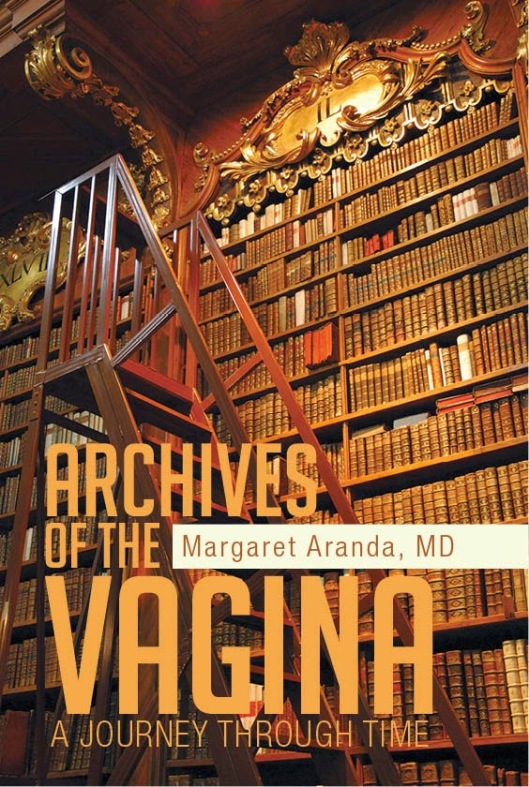
archives-coveraa
Thank you for helping to find this book reviewer. 

~ ~ ~~ ~ ~

Additional Articles by Dr. Margaret Aranda


~ ~ ~

Read Dr Margaret Aranda's Memoirs:


~ ~ ~

Follow Me: Let's Tweet  and be a FB Caring Friend, too!
LIKE my Public Figure FB Page if you will, please!



screen-shot-2017-01-29-at-3-42-35-am

Join The Rebel Patient on Twitter and Facebook


  Follow Dr Aranda on Twitter | Facebook | LinkedIn | TheChronicLifeDiet.com\ | The MD, PhD Is In

Friday, October 12, 2012

Chapter One/Capitulo Uno: From Menarche through Menopause


Raising Girls


There were six girls and one boy in my family, perhaps my “in” on feminine issues.  I was the second oldest, but always felt like the oldest.  My brother was the 7th child, the baby.  I was a little Mommy when I was 8, patting my little brother’s back to sleep every night, and loving it.  Us girls had our “First Talk” in the 70’s, when refrigerators were avocado green, collars were long and sharp, and Led Zepplin’s Stairway to Heaven blared from my room.
“How did you like the book?” my mother asked.  It was a Red Book with Chapters on male and female anatomy, menstrual periods, and intercourse.  What kind of answer should I give? “Yeah, it was um…it was uhmmmm…Yeah.”   I was more stunned than anything.  So this is what my parents were doing, this Intercourse thing?  This is what every married couple does?  Oh my!
I’m not doing any research here on this Chapter; I’m just going by my experience.  Being a girl wasn’t particularly problem-prone in the 70’s.  I walked to school, thumbed to the beach with my friends, and generally was a “Valley Girl” with blonde-streaked, brunette hair in the summertime.  I was in eighth Grade in Catholic School, about to graduate middle school, and our class was going to go on a Field Trip to Disneyland for graduation.  I loved Disneyland.
 I didn’t pluck my eyebrows or wear makeup when I was 13.  I had Wallabees, wasn’t popular in school, and pretty much minded my own business.  Except for the radio blaring from my room when my parents were gone, that is.  I got straight A’s without really trying, and I liked Composition exams over Multiple Choice ones, because it was easy for me to write.  “I Can’t Live” was the first song I recorded onto a tape player then, as well as “A Horse with No Name”. 
There were six girls in our family, and most of us were one year apart from one another.  Back-to-back babies from a Catholic family with no birth control, I suppose. We weren’t the only ones with a big family at our school. Several families were comprised of more than five kids.  That was just the way it was.  My brother was the youngest.
I looked at the Red Book again.  The rest of the book had to do with menstruation.  I had not started my period quite yet, but was destined to do so in just a few months.  After reading that red book, I remember feeling the unfairness of a woman’s Period.  It just seemed messy.  How do you keep yourself clean?  Doesn’t the blood get on your clothes?  Does it hurt to have your Period?  What if you were swimming when it happened?  Wouldn’t the blood get in the water? I was fearful of the unpredictability, the mess, and the cleanup.  I wasn’t worried about the pain.  I was just worried about the social significance of the bleeding; that was my biggest worry.
No one said a word.  I suppose that my older sister had her Period before me, but I don’t remember it.  I don’t remember her having tampons or pads or anything.
But I remember the night my Period started.  Who could forget?  I was sitting on the sofa watching The Twilight Zone with Rodney McDowell.  It was scary, like Halloween.  It was 10:00 pm on a Saturday night and my Father had gone to the store for something.  I felt alone.  I was waiting for him to get back home.  All my sisters were asleep and my stomach felt a little crampy.  I didn’t know that cramps went together with Periods. 
When my Dad pulled into our U-shaped driveway, I didn’t get up.  I let him open the door and bring me some aspirin.  He was attentive and caring, but he didn’t know what was happening, either.  I took the medication and went to get ready for bed.  When I went to empty my bladder for the last time, that’s when it happened.  I noticed the blood.  There wasn’t too much blood, but it was there and I knew I had started my first Period.  There was no one to talk to, no one to question, no one to help.  I guess I could have asked my Father, but the thought did not occur to me.  I didn’t think that it was in his realm.  I would have been embarrassed and I just frankly would not have known what to say, or how to say it.  Awkward.  Yes, it would have been awkward.
So I balled up some toilet tissue and stuffed it in my underwear, wondering who and when I was going to tell some one.  Or ask some one.  I knew that I needed help, but I really didn’t want to ask for it.  “I can handle this, “ I thought. It was too late to call Adrienne or MaryAnn or Lorie. 
That night, I laid in the bottom bunk bed, staring at the wood planks above me.  The mattress heaved in and out of the planks, like the weavings of a straw basket.  I turned to the wall, pillow and hand under my head.  I remembered the times when we played The Clock Game.  My sister on the top bunk would put her whole arm down between the bed and the wall, and make it go Tick Tock like a clock.  On the bottom bunk, I would then try to catch it as she furiously made it go faster and faster.  We were practically wetting our pants it was so funny.  Inevitably, the sisters in the next room would be yelling at us to be quiet, as we frequently played this game when we couldn’t sleep.  That just made the whole thing funnier, you know.  Of course it did. 
I closed my eyes and went to sleep, thinking that times were changing.  I was leaving my childhood behind.  My period marked a sign of womanhood, maturation, entering a one-way street into the future.  Truly,  I no idea that my life had entered a new phase.
The next morning was a Saturday, and I could hear the chirping of the birds.  As was my habit, I peered out the window to check on the sun.  On many days it was cloudy in June, the classic June Gloom of Los Angeles.  Other days, the sun was bright and strong, shining such that my arms headed for the second drawer of my crème-colored dresser.  Tossing aside socks and underwear, I fished for my bikini top and bottom.  Let’s see…yes, they are both there and no one stole them.  Being in a big family was frought with borrowed clothes, missing items, and the need to hide things that were of value to me.  So I was relieved to find both parts of the bikini.
The bright sun signified that it was time to whip out the baby oil and tin foil.  In my mind’s eye, I imagined the next steps to take.  Normally, I would position the foil around my face as I laid on a beach chair.  This of course intensified the suntan and the risk of skin cancer, but no one really knew about the risk of skin cancer then.   The baby oil and tin foil were the habits of the season.
Normally, I would couple the bikini, baby oil, and tin foil with a selection of Diet Shasta.  My Dad would purchase a case of soda, ten different flavors.  The case was on the floor in the kitchen, next to the avocado green telephone that hung on the wall.  I would pour one out into a glass of ice and take all this gear outside with me outside to lay out in the sun.  
My favorite place to lay out was in the front yard, because we had a Golden Retriever and a mutt in the backyard.  If I laid out in the backyard, they just refused to leave me alone.  Licking.  I would get licked and licked and it was simply gross.  Besides, there were more flies and I didn’t want them sticking to my baby oil.  So off to the front yard I prepared to go, seeing in my mind’s eye all the supplies in hand. La-la-la…
Oops.  Yes and no.  As my hand came out of my dresser drawer now, my image of laying out in front suddenly dashed out of my focus.  I looked down at my legs, squatted down with the black bikini strewn across. 
I started my Period last night.  I started my Period last night, I said! 
I didn’t have any one to go to.  I wish that one of my friends had a mother that I could talk to, as I figured the conversation was over with my own mother.  My shoulders hunched downward in defeat and despair as the dawning came over me.  I was alone. 
Back then, girls were not really taught to go to college, to get a job, or to think about a career goal.  None of my friends wanted to be anything. For sure Adrienne with her blonde, floating hair and immaculate smile was already attracting boys that could drive.  Destined to be a model or an actress, everyone considered her to be the most popular girl in school.  Her mother was a nurse.  She worked nights, but it seemed like she really didn’t work too much, as she was always home.  I don’t remember that she was particularly tired or crabby or anything.  She seemed like a normal mother but I didn’t know her well enough to ask about my Period. 
In fact, I didn’t even tell my girlfriends about it.  Somehow, I imagined that it was up to me to figure it out for myself.  I was going to have my Period for a long time now, and it wasn’t gong to go away. 
I thought about telling MaryAnn or Lorie.  MaryAnn had an older sister too, and maybe Carla knew about Periods.  Ahhh, but Carla played basketball and volleyball and was super athletic.  She would probably think I was being baby-ish if I asked, and then MaryAnn would have to know about it to, by default. 
Peer pressure seemed to dictate that girls didn’t talk to other girls about starting their Period.  I was 13 years old, in 8th grade, and I was getting ready to enter Catholic High School next year.  I though well, if I’m big enough to go to High School, then I’m big enough to figure it out on my own.
I don’t know why I didn’t want my friends to know I started my Period.  I just thought that it was supposed to be a secret thing.  No one ever talked to me about it.  Older sisters were everywhere, and surely they were already on their Periods.  Why didn’t they sit us down and tell us about it?  You’d think that it would be a chance for them to be the ‘big’ sister and give us advice and tell us what to expect, what to use, etc.  There must be so much to know, isn’t that true?  Since no one had really talked to me about having a Period before, my conclusion was that I wasn’t supposed to talk about it.  Well, I thought, let me think about this one more time before I keep it quiet.
Lorie was the cool-headed friend that was level.  Nothing startled her.  She could handle ten frightful situations without having a meltdown, but…I couldn’t go to her.  I was too embarrassed.  How do I say the word, “vagina”?  How could I tell her that I had blood coming from my Private Part?  Would she think less of me?  Would she be jealous?  Maybe she already started her Period?  No, why would she start her Period and then not tell me?  She couldn’t have started it yet. Ahhh, but if she did start her Period and she didn’t tell me, then I’m stuck again!  Maybe we’re not supposed to talk about it!  Oh no! 
I threw down my bikini on the mustard-and black shag wall-to-wall carpeting.  It was well worn by now, dog hair scattered here and there.  I didn’t care.  I was bleeding!  What do I do about the blood? Oh my goodness!  If I squat, does that make the blood come out worse?  What if my Dad sees it on my clothes?  What if my sisters see it?  Surely they will point at me and laugh if they see blood. 
So I thought I should hide it.  

BUY IT NOW: www.drmargaretaranda.tateauthor.com/other-works/
________________________


Había seis mujeres y un varón en mi familia, tal vez mi "en" en temas femeninos. Yo era el mayor segundo, pero siempre me sentí como el más antiguo. Mi hermano era el séptimo hijo, el bebé. Yo estaba un poco mamá cuando yo tenía 8 años, palmeando la espalda de mi hermano pequeño a dormir todas las noches, y me encanta. Nosotras las chicas tuvimos nuestra "Talk inicio" en los años 70, cuando los refrigeradores eran aguacate verde, collares eran largos y afilados, y Led Zeppelin Escalera al Cielo resonó desde mi habitación.
"¿Cómo te gusta el libro?" Le pregunté a mi madre. Era un libro rojo con capítulos sobre anatomía masculina y femenina, los períodos menstruales, y el coito. ¿Qué clase de respuesta debo dar? "Sí, es um era ... era uhmmmm ... Si." Estaba más sorprendido que otra cosa. Así que esto es lo que mis padres estaban haciendo, esta cosa sexual? Esto es lo que cada pareja casada hace? Oh my!
No voy a hacer ninguna investigación aquí en este capítulo, yo sólo voy por mi experiencia. Siendo una niña no era particularmente propenso a problemas en los años 70. Me acerqué a la escuela, pulgar a la playa con mis amigos, y en general fue una "Valley Girl" con rubia con estrías, pelo negro en el verano. Yo estaba en el octavo grado en la escuela católica, a punto de graduarse de la escuela media y la clase iba a ir a una excursión a Disneyland para la graduación. Me encantó Disneyland.
 Yo no desplumar las cejas o usar maquillaje cuando tenía 13 años. Tuve Wallabees, no era popular en la escuela, y más o menos importaba mi propio negocio. A excepción de la radio a todo volumen desde mi habitación cuando mis padres se habían ido, eso es. Me dieron las mejores calificaciones sin siquiera intentarlo, y me gustó más de los exámenes de composición de opción múltiple, porque era fácil para mí escribir. "No se puede vivir" fue la primera canción que grabé en una grabadora entonces, así como "A Horse with No Name".
Había seis niñas en la familia, y la mayoría de nosotros éramos un año de diferencia el uno del otro. Back-to-back a los bebés de una familia católica, sin control de la natalidad, supongo. No éramos los únicos con una gran familia en la escuela. Varias familias se componían de más de cinco hijos. Eso fue sólo la forma en que fue. Mi hermano era el menor.
Miré el libro rojo de nuevo. El resto del libro tiene que ver con la menstruación. Yo no había comenzado mi período todavía, pero estaba destinado a hacerlo en tan sólo unos pocos meses. Después de leer el libro rojo, recuerdo sentir la injusticia de la menstruación. Me parecía sucio. ¿Cómo te mantienes limpio? ¿Acaso la sangre baje en su ropa? ¿Le duele tener su período? ¿Y si estuviera nadando cuando ocurrió? ¿No sería la sangre de meterse en el agua? Yo tenía miedo de lo imprevisible, el desorden y la limpieza. Yo no estaba preocupado por el dolor. Yo estaba preocupado por el significado social de la hemorragia, que era mi mayor preocupación.
Nadie dijo una palabra. Supongo que mi hermana mayor tuvo su período antes de mí, pero yo no lo recuerdo. No recuerdo sus tampones o compresas tienen ni nada.
Pero recuerdo la noche en que mi periodo comenzó. ¿Quién podría olvidar? Yo estaba sentado en el sofá viendo la zona crepuscular con Rodney McDowell. Daba miedo, como Halloween. Era las 10:00 pm del sábado por la noche y mi padre se había ido a la tienda a comprar algo. Me sentía solo. Yo lo estaba esperando para volver a casa. Todos mis hermanos estaban dormidos y mi estómago se sentía un poco con calambres. Yo no sabía que los calambres se fueron juntos con puntos.
Cuando mi papá se detuvo en nuestro camino de entrada en forma de U, que no se levantó. Dejé que abrir la puerta y tráeme una aspirina. Él era atento y cariñoso, pero él no sabía lo que estaba ocurriendo, tampoco. Me tomé la medicación y fue a buscar a la cama. Cuando fui a vaciar mi vejiga, por última vez, fue cuando sucedió. Me di cuenta de la sangre. No había demasiada sangre, pero estaba allí y sabía que yo había comenzado mi primer período. No había nadie con quien hablar, nadie pregunta, nadie para ayudar. Supongo que podría haber pedido a mi padre, pero la idea no se me había ocurrido. No pensé que estaba en su reino. Me hubiera sentido avergonzado y yo sólo francamente no habría sabido qué decir o cómo decirlo. Awkward. Sí, habría sido difícil.
Así que hizo una bola con un poco de papel higiénico y se lo metió en mi ropa interior, preguntándose quién y cuando me iba a decir a alguien. O pregunte a alguien. Sabía que necesitaba ayuda, pero yo realmente no quería pedir. "Yo puedo manejar esto", pensé. Era demasiado tarde para llamar a Adrienne o MaryAnn o Lorie.
Esa noche, me acosté en la cama litera de abajo, mirando a los tablones de madera por encima de mí. El colchón exhaló dentro y fuera de las tablas, al igual que los tejidos de una cesta de paja. Me volví hacia la pared, almohada y la mano debajo de mi cabeza. Recordé los tiempos en que las reglas del juego del Reloj. Mi hermana en la cama de arriba se le pasó el brazo por completo entre la cama y la pared, y hacer que se vaya Tick Tock como un reloj. En la litera de abajo, me permitiría tratar de atraparlo mientras ella con furia hizo que vaya más rápido y más rápido. Estábamos prácticamente mojar los pantalones era tan gracioso. Inevitablemente, las hermanas en la habitación de al lado se nos grita que se calle, ya que con frecuencia han desempeñado este juego cuando no podía dormir. Que acaba de hacer todo más divertido, ya sabes. Por supuesto que lo hizo.
Cerré los ojos y me fui a dormir, pensando que los tiempos estaban cambiando. Yo salía de mi infancia atrás. Mi período marcó un signo de la feminidad, la maduración, entrar en una calle de un solo sentido en el futuro. En verdad, yo no sabía que mi vida había entrado en una nueva fase.
A la mañana siguiente era sábado, y pude oír el canto de los pájaros. Como era mi costumbre, me asomé por la ventana para ver cómo el sol. Muchos días estuvo nublado en junio, el clásico Gloom junio de Los Angeles. Otros días, el sol era brillante y fuerte, brilla de tal manera que mis brazos se dirigió al segundo cajón de mi tocador color crema. Tirando a un lado calcetines y ropa interior, me pescaron mi bikini y el fondo. Vamos a ver ... sí, son los dos allí y nadie les robó. Estar en una gran familia se frought con ropa prestada, elementos que faltan, y la necesidad de ocultar las cosas que eran de valor para mí. Así que me sentí aliviado al encontrar las dos partes del bikini.
El brillante sol significaba que era hora de sacar de repente el aceite de bebé y papel de aluminio. En mi mente, me imaginaba los próximos pasos a tomar. Normalmente, me gustaría colocar el papel de aluminio alrededor de mi cara cuando me puso en una silla de playa. Por supuesto, esto intensificó el bronceado y el riesgo de cáncer de piel, pero en realidad nadie sabía sobre el riesgo de cáncer de piel entonces. El aceite de bebé y papel de estaño eran las costumbres de la época.
Normalmente, lo haría pareja el bikini, aceite de bebé, y papel de aluminio, con una selección de la dieta Shasta. Mi papá se compra una caja de soda, diez sabores diferentes. El caso estaba en el suelo de la cocina, al lado del teléfono aguacate verde que colgaba en la pared. Me gustaría echar un cabo en un vaso de hielo y tomar todo este engranaje fuera conmigo fuera a exponer al sol.
Mi lugar favorito para diseñar estaba en el patio delantero, porque teníamos un Golden Retriever y un perro callejero en el patio trasero. Si puse en el patio, sólo se negó a dejarme en paz. Licking. Me dejarse lamer y lamer y era simplemente asqueroso. Además, había más moscas y yo no quería que se pegue a mi aceite de bebé. Así que fuera al patio delantero me preparaba para ir, viendo en mi mente todo el material en la mano. La-la-la ...
Oops. Sí y no. Como mi mano salió de mi cajón de la cómoda, mi imagen de sentar en frente de repente salió corriendo de mi enfoque. Me miré las piernas, se puso en cuclillas con el bikini negro salpicado de ancho.
Yo comencé mi período de anoche. Yo comencé mi período de anoche, he dicho!
Yo no tenía a nadie a ir. Me gustaría que uno de mis amigos tenían una madre que podía hablar, ya que pensé que la conversación había terminado con mi propia madre. Mis hombros encorvados hacia abajo en la derrota y la desesperación como el amanecer se apoderó de mí. Yo estaba sola.
En aquel entonces, las niñas no se les enseñó realmente para ir a la universidad, conseguir un trabajo, o para pensar en una meta profesional. Ninguno de mis amigos querían ser cualquier cosa. Para asegurarse de Adrienne con su pelo rubio, flotante y una sonrisa impecable ya estaba atrayendo a los niños que podrían conducir. Destinado a ser un modelo o una actriz, todo el mundo la consideraba ser la chica más popular del instituto. Su madre era una enfermera. Ella trabajaba de noche, pero parecía como si realmente no funcionó demasiado, ya que ella siempre estaba en casa. No me acuerdo que estaba particularmente cansado o de mal humor, ni nada. Parecía como una madre normal, pero yo no sabía lo suficiente como para preguntar acerca de mi período.
De hecho, ni siquiera le digo a mis amigas sobre ella. De alguna manera, me imaginaba que era a mí a averiguarlo por mí mismo. Yo iba a tener mi periodo durante mucho tiempo ahora, y no era gong que se vaya.
Pensé en decirle a MaryAnn o Lorie. MaryAnn tenía una hermana mayor también, y tal vez Carla sabía de períodos. Ahhh, pero Carla jugó al baloncesto y voleibol y era súper deportivo. Probablemente pensaría que estaba siendo niño-ish le pregunté si, a continuación, MaryAnn tendría que saber al respecto para, de forma predeterminada.
La presión de grupo parece dictar que las niñas no hablar con otras chicas acerca de cómo iniciar su período. Tenía 13 años de edad, en el 8vo grado, y me estaba preparando para entrar en la High School secundaria católica el próximo año. Pensé bien, si soy lo suficientemente grande como para ir a la escuela secundaria, entonces yo soy lo suficientemente grande como para averiguarlo por mi cuenta.
No sé por qué yo no quería que mis amigos sepan que comencé mi período. Pensé que se suponía que era una cosa secreta. Nadie me habló de él. Las hermanas mayores estaban por todas partes, y seguramente ya estaban en sus períodos. ¿Por qué no nos sentamos y nos dicen al respecto? Uno pensaría que sería una oportunidad para ellos para ser el 'gran hermana y nos dan consejos y nos dice qué esperar, qué usar, etc Debe haber mucho que saber, ¿no es cierto? Puesto que nadie había hablado realmente a mí por tener un período anterior, mi conclusión fue que no iba a hablar de eso. Bueno, pensé, déjame pensar sobre esto una vez más antes de mantenerlo en secreto.
Lorie era el amigo de cabeza fría que era nivel. Nada le sobresaltó. Podía manejar diez situaciones terribles sin tener una crisis, pero ... no pude ir a verla. Yo estaba demasiado avergonzada. ¿Cómo puedo decir la palabra "vagina"? ¿Cómo podía decirle que había sangre saliendo de mi parte privada? ¿Se piensan mal de mí? ¿Estaría celosa? A lo mejor ya ha comenzado su período? No, ¿por qué iba a iniciar su período y luego no me lo dijiste? Ella no podría haberlo empezado. Ahhh, pero si lo hizo comenzar su período y ella no me lo dijo, entonces me tengo que quedar otra vez! Tal vez no deberías hablar de ello! Oh no!
Tiré mi bikini en la mostaza y negro alfombras shag de pared a pared. Se llevaba bien por ahora, pelo de perro esparcidos aquí y allá. No me importaba. Estaba sangrando! ¿Qué debo hacer con la sangre? ¡Oh Dios mío! Si cuclillas, ¿eso que la sangre salga peor? ¿Y si mi papá lo ve en mi ropa? ¿Qué pasa si mis hermanas lo ven? Seguramente se me señalan y se ríen cuando ven sangre.
Así que pensé que debía ocultar.


Comprar Dr. Aranda's libros,  click aqui, por favor:
~~~~~~~~~~~~~~~~~~~~~~~~~~~~~~~~~~~~~~~~~~~~~~~~~~~

Dr. Margaret Aranda's Books:

No More Tears en Espanol
Face Book Page: Stepping from the Edge
Little Missy Two-Shoes Likes to go to School
From Menarche to Menopause: A Journey through Time


To Order Dr. Aranda's books, please click here:
~~~~~~~~~~~~~~~~~~~~~~~~~~~~~~~~~~~~~~~~~~~~~~~~~~~


Additional Articles by Dr. Margaret Aranda

Medical Disclaimer: Nothing on this website is meant to diagnose, treat, or practice medicine. You must be seen in person by a physician for appropriate and individual medical treatment. If you have an emergency, call 9-1-1 in the USA.

Link Disclaimer: We are not responsible for any links that go outside of this website.

Full Disclosure: Margaret A. Ferrante, M.D.  is an Institute Physician with Cenegenics Medical Institute.  She receives no monetary compensation for hosting this website you are on, which is independent and not affiliated with Cenegenics. The information presented is for education and awareness.  Dr. Ferrante currently sees patients out of the Cenegenics office in Beverly Hills, CA. 
To book an appointment for a free Consultation, please email her at: mferrante@cenegenics.com

WITHDRAWAL OF OPIOIDS AND PAIN MANAGEMENT WITHOUT OPIOIDS By Dr Forest Tennant   We are pleased to share information from Dr. Forest Ten...